Why extreme risk cannot be measured
Risk Systemic risk AI Models
The financial system generates zettabytes of data every day. Feed enough of it into a sufficiently powerful machine learning model, and we capture all the interactions and predict outcomes far better than we can today.
We can even let AI build the stress scenarios against which we judge the institutions that make up the system, and so regulate better. More economic growth, without the damaging crises.
A lot of people claim this is possible.
It sounds compelling, and for ordinary risk it is even true. Data describes what has already happened, and there is plenty of it in the middle of the distribution, the day-to-day fluctuations.
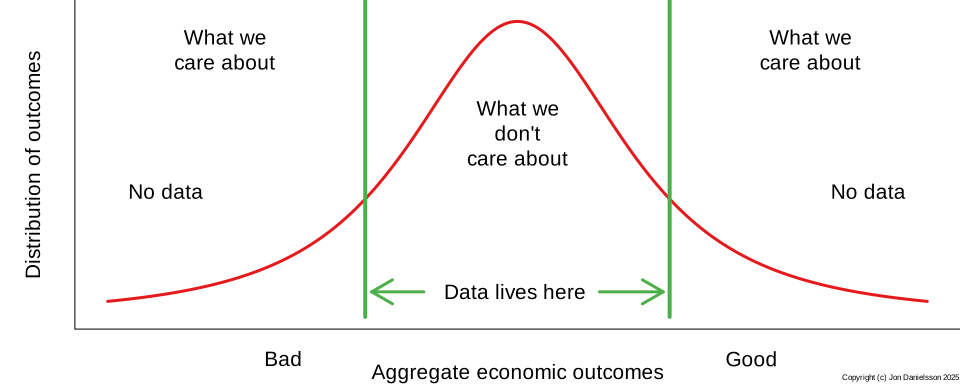
The middle is what we can measure. In the tails, where the crises happen, we have no data. That is not because nothing happens there. On the contrary, it is the most important bit. The problem is there is none.
The reason is that outcomes in the tails are determined by future human decisions. When the next crisis hits, what happens will be decided by hedge fund managers, bank CEOs, regulators, central bank governors and finance ministers. Those decisions have not been made yet, and no dataset contains them.
Nobody could have predicted that Karin Keller-Sutter, the Swiss finance minister, would resolve Credit Suisse in March 2023 by writing CHF 16 billion of AT1 bonds down to zero while shareholders were handed CHF 3 billion, inverting the usual hierarchy of who takes losses first. A Swiss court ruled the write-down unlawful two years later. Nobody predicted that either. Nobody could have predicted that Janet Yellen, the US Treasury Secretary, would make every depositor in Silicon Valley Bank whole, rescuing Circle, the issuer of the USDC stablecoin, and a string of Chinese biotech firms.
The way we respond to crises is to hold an emergency meeting, usually in the ministry of finance, where the governing elite — the government, the central bank, the supervisors, the courts, the affected banks — come together and reach a collective decision. As Katharina Pistor argues in her A Legal Theory of Finance (2013), even the law is not sacrosanct. When the law stands in the way of resolving a crisis, we break it in the name of the higher objective. How can we predict what these people will do? We cannot.
Technically, the reaction function of the key decision makers is unknown. Worse, it is an unknown-unknown, which makes extreme financial risk uncertain in the sense of Frank Knight (1921). What is uncertain in Knight's sense cannot be modelled, measured or stress tested, no matter how much data we have.
The deeper reason is a distinction Hyun Song Shin and I drew years ago, between exogenous and endogenous risk (Danielsson and Shin, 2002). Exogenous risk comes from shocks that arrive from outside the system. It can be measured from history, which AI excels at. Endogenous risk is generated and amplified inside the system, by the strategic interaction of the people who make it up. It surfaces only in extreme stress, when self-preservation and mistrust of counterparties turn prudent individual decisions into a collective catastrophe. The greatest damage is always done by risk of the endogenous kind, and that is the kind that leaves no usable data behind. That is both because every crisis is unique in its detail and because its outcomes are determined by human beings.
In other words, it is practically impossible to measure or quantify the chance of extreme outcomes in the financial system. It is also why it is axiomatic that crises happen where no one is looking, and why almost all the empirical frameworks that aim to model and quantify crises are useless.