Risk appetite, growth and crises
Risk Crises Systemic risk
Hyman Minsky argued that the calm times sow the seeds of the next crisis. When nothing goes wrong for long enough, lenders and borrowers take on more risk, debt builds up, and it takes less and less to knock the system over. Stability is destabilising.
A good story we decided to test in two papers I wrote with Marcela Valenzuela and Ilknur Zer, both in the Review of Financial Studies, Learning from History: Volatility and Financial Crises in 2018 and The Impact of Risk Cycles on Business Cycles: A Historical View in 2023. The first covers 60 countries and up to 211 years, the second 73 countries from 1900 to 2016.
Measuring risk appetite
We needed a measure of risk appetite with a long history. No such risk metric exists, neither the VIX, nor the current level of volatility, nor the dollar.
What we use instead is how long risk has stayed below what people have come to expect, a proxy for how safe investors think the world is. Take volatility, \(\sigma_t\) , split it into a trend, \(\tau_t\) , and a deviation from it, and count the years the deviation is negative
\[X_t = 1 \text{ when } \sigma_t < \tau_t \text{ and } 0 \text{ otherwise}\] \[\text{DLR}_t = (\text{DLR}_{t-1} + X_t) X_t\]The duration of low risk, DLR, counts how long the quiet has lasted, and goes back to zero in any year when volatility is no longer below its trend. That is the simplest version. In the 2023 paper we discount the earlier years, so what happened a decade ago counts for less than last year.
The mirror image is the duration of high risk, DHR. It counts the years volatility stays above its trend.
One year of low risk tells us little. The longer it lasts, the more comfortable with risk we become.
Results
Start with high risk.
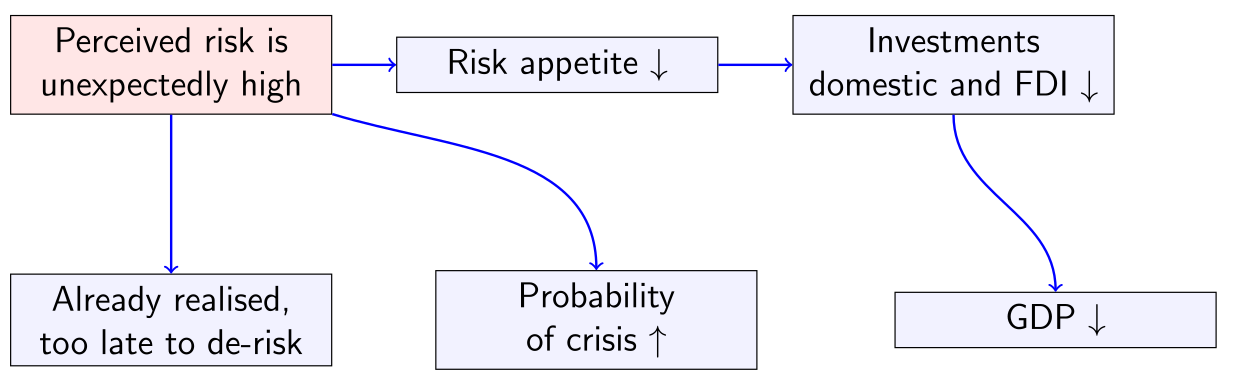
Risk appetite falls, investment and cross-border flows fall with it, and growth weakens. But by the time risk is high, the damage is done. It is too late to do anything about the causes.
Then low risk.
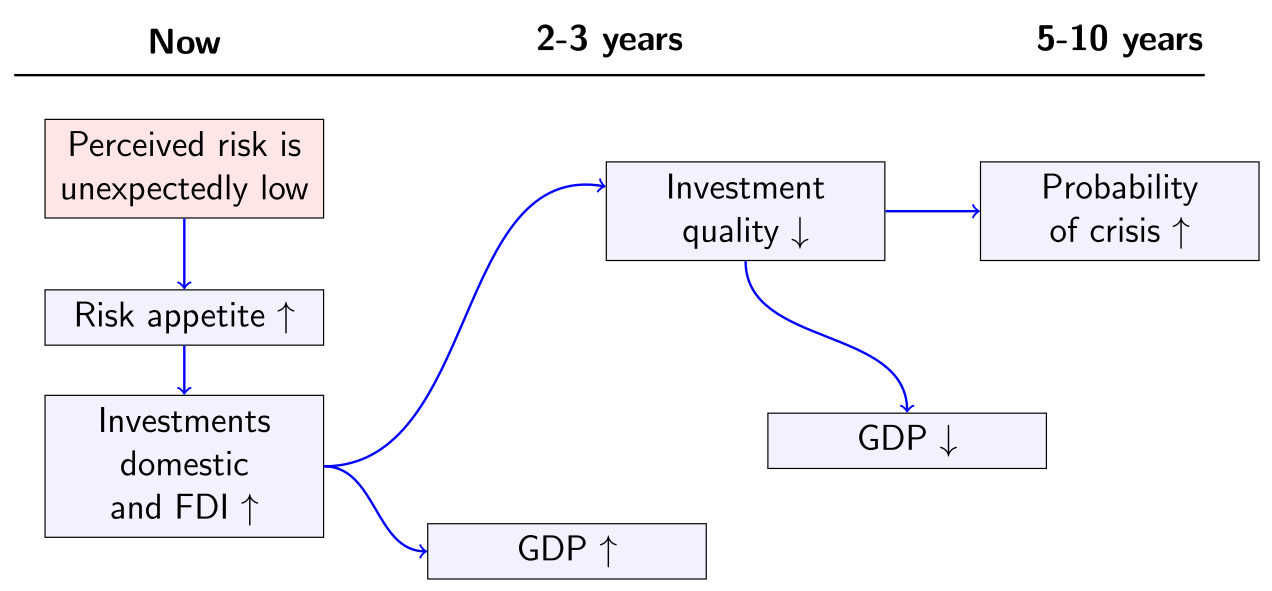
Risk appetite rises, lending increases and the loans are more risky. Investment goes up, and growth with it.
But one cannot make good investments forever. Investment quality falls, and the estimated effect on growth turns negative around the second year. Our 2018 paper finds that prolonged low volatility predicts banking crises.
Credit growth amplifies the reversal. Over the whole horizon low risk still helps growth, but that turns around when credit growth is excessive, or when the calm lasts unusually long. That is also why low risk and credit growth are two useful warning signs.
Global and local
The global measure is the GDP-weighted average of the national ones, and the global cycle matters more than the local one. Money moves across borders, and so does risk appetite. It works on growth through portfolio flows, investment and the quality of borrowers.
The numbers are large. A one-standard-deviation increase in global DLR raises growth by 1.5 percentage points over the first two years and then cuts it by 0.8. Across the boom and the reversal it still adds about 0.7. The local measure does the same, with a smaller swing.
High risk only goes one way. A one-standard-deviation increase in local DHR cuts growth by 0.8 percentage points over the same year and the next, and the global measure does about double that, 1.5.
And US risk appetite is closely tied to the global cycle.
Policy implications
Several policy implications follow from these results. First, the indicators of instability. The most common ones in practical use are volatility, the VIX, CDS spreads, CoVaR, SRISK and the ECB's CISS. All capture high risk, which means that they only react once the decisions that cause the damage have been made. They are correlated with the problem, not predictive of it. The signal comes too late to act on. We might as well subscribe to the Financial Times, whose front page will flash "crisis" at the same time as these indicators.
Two indicators that do warn early are credit growth and low risk. And low risk predicts credit growth.
The harder part is acting on it as I discuss in The Next Crisis.