The next crisis
Systemic risk Crises Policy AI
Hemingway, in The Sun Also Rises:
"How did you go bankrupt?" ... "Gradually and then suddenly."
Start with what the commentariat worries about today. AI comes in with two entries, AI-enabled cyber attacks and an investment bubble. We then have long-term interest rates hitting 5% and excessively indebted sovereigns. Add to that pressure on central bank independence, energy shocks, tariffs, private credit and banks sitting on loans backed by empty offices. We can surely think of more.
All this in times of increasing demand for government expenditure, like national defence, health care and pensions. Throw in the lack of growth and, finally, ageing populations, climate and populism.
Even though we could have a crisis originating from any of these individual factors, a more likely outcome is many of them interacting and amplifying each other.
That is endogenous risk. No crisis is purely endogenous or exogenous, they are always a combination of an initial exogenous shock, one that comes from outside, followed by an endogenous response, how the system reacts. The same initial shock can one day whimper out into nothing, and the next blow up into a global crisis.
Consequently, when trying to identify the next crisis, a useful starting point is to recognise that while all crises are different in detail, indeed unique, they all share the same handful of fundamental vulnerabilities. The most fruitful way to do that is to look at the fundamentals, and the best way to start is with the debt identity.
The debt identity
Crises are almost always about debt, and the natural place to begin is the government debt-to-GDP ratio, which evolves according to
$$ \Delta d_t \approx (r_t - g_t) d_{t-1} - pb_t + \text{other}_t $$
where \(d_t\) is the debt ratio, \(r_t\) the effective real interest rate on the debt, \(g_t\) real GDP growth and \(pb_t\) the primary balance, revenues minus non-interest spending, relative to GDP. Interest makes the debt ratio grow, while growth and primary surpluses shrink it.
The last term, \(\text{other}_t\) , is what changes the debt without passing through the deficit, such as government lending, asset sales or spending recorded in one year and borrowed for in another.
The term \((r_t - g_t) d_{t-1}\) is the snowball, how much the debt ratio grows by itself. If the interest rate is below the growth rate, the debt ratio falls even with a balanced primary budget. But when the interest rate is above the growth rate, the government has to run a primary surplus just to stop the debt ratio rising. The bigger the debt, the bigger that surplus.
With debt at 150% of GDP and the interest rate one point above growth, it takes a primary surplus of about 1.5% of GDP just to keep the ratio where it is.
The interest rate in the debt identity is not the headline 5% we see in the bond market, since those are nominal rates on new long-term borrowing, for maturities of ten years or more. The effective rate is what the whole stock of debt pays, net of inflation. Higher market rates feed into it as fixed-rate debt matures and is refinanced, and sooner where the debt is floating-rate or index-linked, while inflation changes the real cost at once.
But governments tend not to repay their debt, instead rolling it over, so the market rates show where the effective rate is heading.
For now, the snowball works for most governments as they still pay a nominal interest rate of about 3.5% or less on their debt, well below what the market asks now. In the US, the UK, France and Germany, the debt is growing because of the deficits.
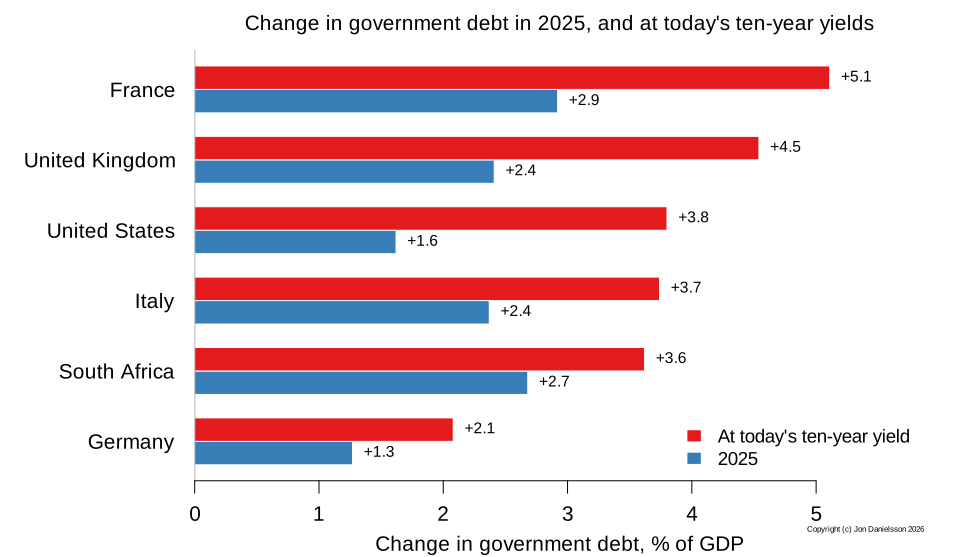
What if the whole debt had paid today's ten-year yield in 2025? In the US the debt ratio would have risen by 3.5% of GDP, not 1.6%, and in France by more than 5%. The numbers are in The debt snowball in numbers.
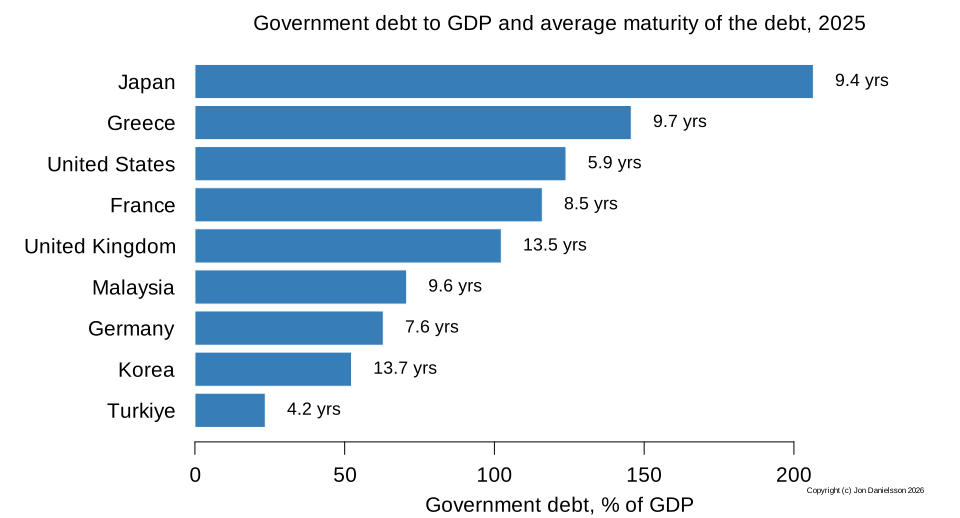
How fast the higher interest bill arrives depends on the maturity of the debt. The second chart shows government debt to GDP in 2025, with the average maturity of the debt next to each bar.1 Suppose a government with an average maturity of six years refinances a sixth of its debt every year. Then, if yields stay where they are, a rough calculation adds about 0.3% of GDP a year to the US interest bill, about 0.3% to the French bill and about 0.1% to the UK bill. Actual redemption schedules are lumpier than that.
Where the worries land
Start with the ones we know are coming, like ageing and climate. The labour force shrinks, so growth falls. Retirees run down their savings, and that raises the interest rate. Pensions, health and care cost money, and so do subsidies and adaptation. Every one of those pushes the arithmetic the wrong way.
Then the ones we choose. Rising defence spending goes straight into the primary balance. Tariffs lower growth, and retaliation makes it worse, while the higher prices keep interest rates up. Energy shocks do much the same, especially once the government starts paying people's bills, as it did in 2022.
Now the surprises. Banks have always been a main source of systemic risk. Banks usually get into difficulty through real estate, and today the worry is commercial property. Lending to the real economy slows, which slows growth. Private credit is the newer one and the question is how much of it is funded by the banks.
AI makes crises harder to handle. Financial institutions use AI to react far faster than any human, so what once took days or weeks may play out in minutes or hours, and the authorities have little time to step in. AI-enabled cyber attacks are most dangerous when they coincide with market stress, the double coincidence.
The investment boom cuts both ways. We are spending a lot of money on data centres, which boosts the economy today, and AI may well raise white-collar productivity, and with it growth. Whatever happens to the companies doing the investing, we will be left with the investments.
But much of it is borrowed, which puts the bond markets under strain and may push up interest rates, including the ones governments pay. And when rates are rising while the price the AI companies can charge for a given capability keeps falling, their financing becomes increasingly precarious.
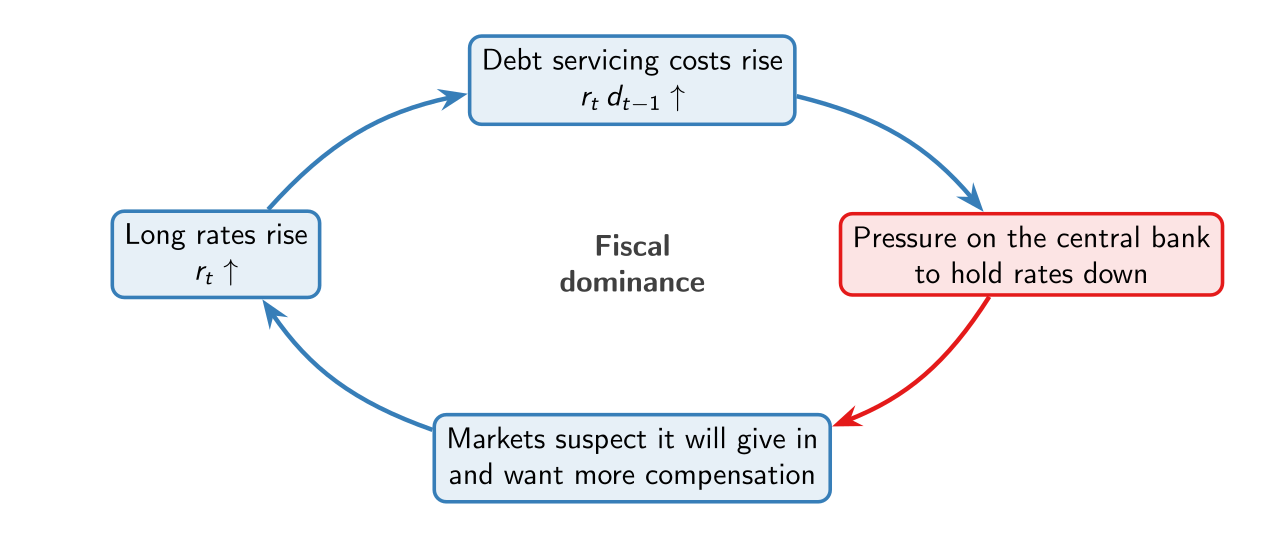
Then there is politics. When the markets suspect the central bank will hold rates down to help the government, they want more compensation for holding its debt. That also eats into the credibility the central bank will need when the crisis comes.
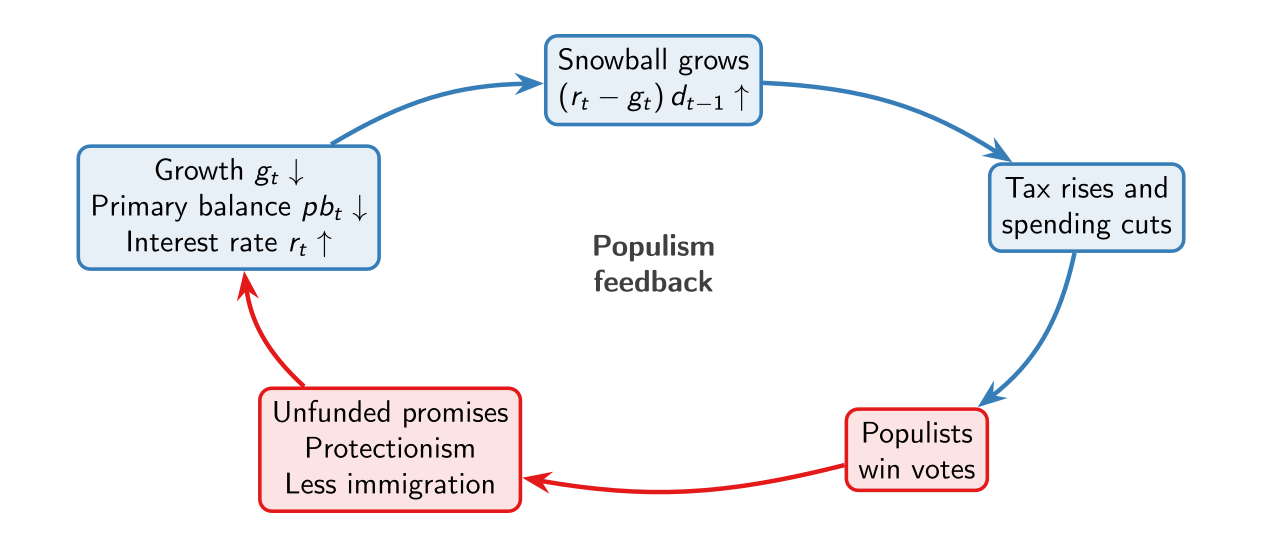
Populism is in all of it. Protectionism and less immigration lower growth. Unfunded promises and tax cuts weaken the primary balance. Policy uncertainty adds to the interest rate. Populism undermines trust in institutions, so it makes a crisis harder to fight and the debt arithmetic harder to fix. And it feeds on the arithmetic itself, because a growing snowball means tax rises and spending cuts, which is what populists run against.
How it all goes pear-shaped
An indebted country may enter a debt death spiral, where the government faces increasingly costly obligations when it is difficult to raise taxes. More and more needs to be borrowed to service the existing debt and meet demands for public services. In the debt identity, the debt ratio rises, investors demand higher risk premia, the effective rate goes up and the snowball grows, so the debt ratio rises further.
The way it likely ends is a fiscal heart attack, or in Ray Dalio's terminology, a debt-induced heart attack. The markets refuse to roll over the debt, and the government is left with two bad choices, either emergency measures or default.
What that means depends on the currency. A government borrowing in its own money never runs out of it, so the adjustment comes through inflation and the exchange rate instead. Inside the euro area there is no such escape, and the question becomes who pays.
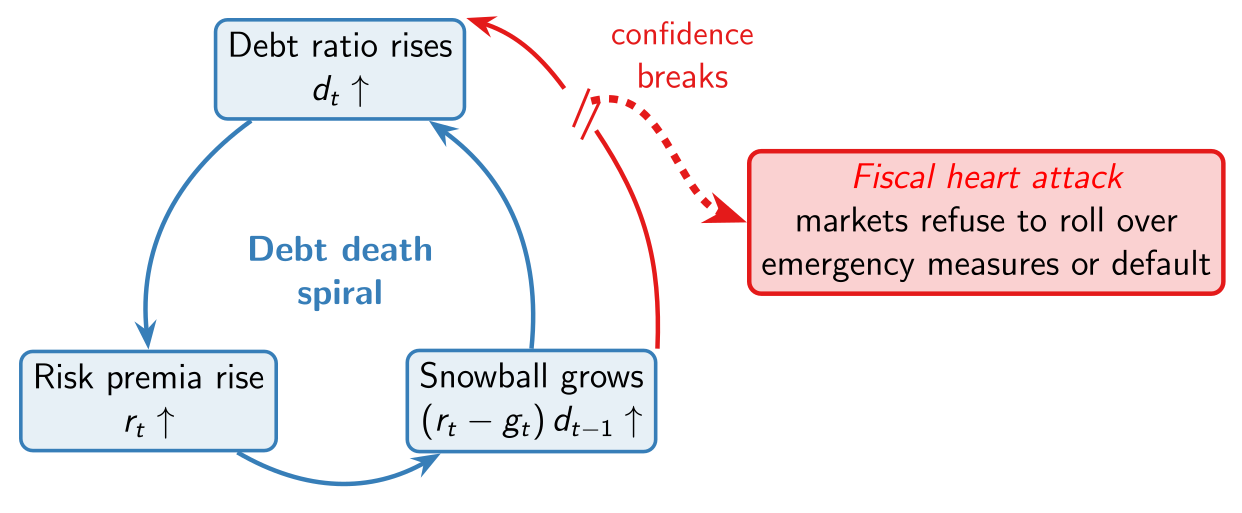
We economists explain the sudden jump with the concept of multiple equilibria. The same fundamentals (debt and growth) can support two outcomes. Confident investors happily roll the debt over at low rates and the debt is sustainable, but if they lose confidence, they demand high rates, and those high rates make the debt unsustainable. So the fear is self-fulfilling.
The fundamentals decide whether the bad equilibrium is possible, and then something small, a trigger, pushes us into it. With a steady drip of potential triggers, there is no point in trying to predict one. All we can do is judge how strongly the fundamentals push us towards the bad equilibrium, and how strongly the forces that hold us back, above all the authorities' ability to respond, pull the other way.
Market discipline
The bond market is a disciplining device. Mitterrand learned that in 1983, when market pressure forced him to abandon his programme and turn to austerity two years into his presidency. The UK learned it again in 2022.
For years the rate on government debt was closer to an administered price than a market one. Many of the buyers (pension funds, insurers and banks) hold government bonds because regulation and their own liabilities push them there. After 2008 the central banks were buyers too, rates were at zero, and in Japan the central bank targeted the ten-year yield outright. That is changing.
The US ten-year Treasury yield has touched 5% and the 30-year is near a 19-year high. This suggests investors fear a switch to the bad equilibrium is increasingly likely, and are demanding higher rates in response.
Equally telling is who now holds the debt. American pension funds used to keep close to 40% of their assets in bonds, and now hold 10% to 15%, with European funds down to about 20% from 35%. Hedge funds held around $2 trillion of Treasuries at the end of 2025, nearly three times their holdings five years earlier and a record 7% of the market, much of it borrowed.
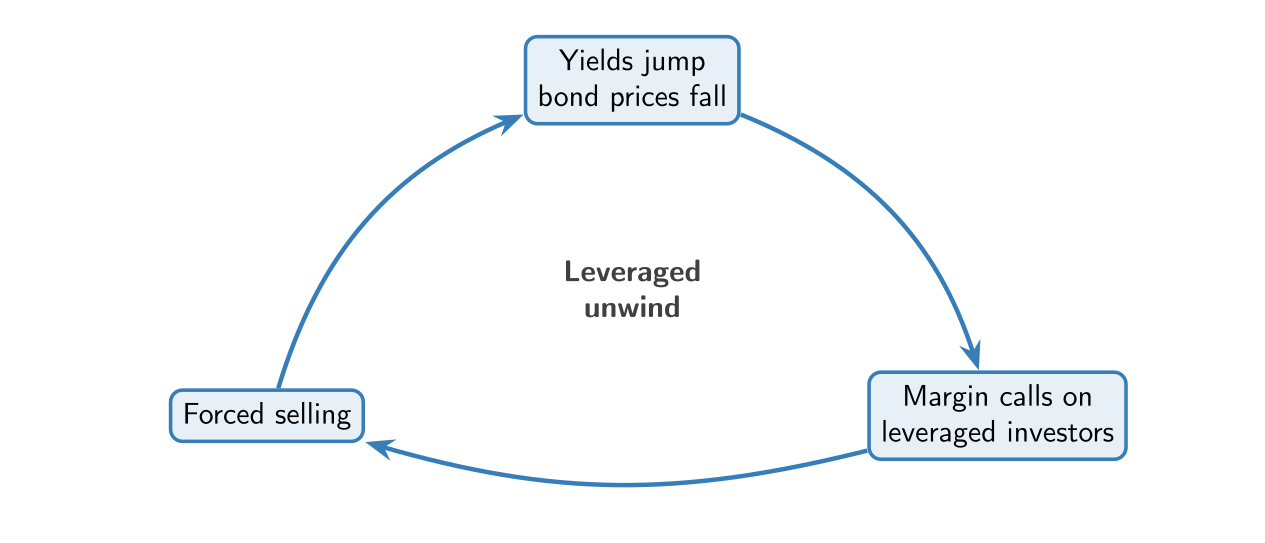
That matters for which equilibrium we end up in. Hedge funds may behave differently in the markets from the more traditional investors. The ECB has warned that such investors can amplify stress when they unwind, and the New York Fed has been asking what their growing role means for the Treasury market.2
Running out of dry powder
The worse the debt arithmetic, the smaller the shock needed to trigger the fiscal heart attack. How small depends on the government's ability to respond, since a shock it can absorb cheaply is not systemic. We could afford significant monetary and fiscal expansion in 2008 and 2020, but that might be impossible today. Governments are more indebted, and after the inflation that followed 2020, it is much harder to monetise interventions. We may have run out of dry powder.
Even the fear of that has two consequences.
First, it takes less to set off the crisis. If a shock like 2008 or 2020 comes today, it is increasingly likely to push us into the bad equilibrium.
Second, the markets worry about it too. They are more alive to the possibility that the authorities cannot come to the rescue, so they are quicker to sell at the first sign of trouble, and that selling can itself bring on the crisis. Endogenous risk, in other words, where the market participants' own reactions make a crisis more likely. The shift in who holds the debt makes that more likely still.
Minsky, the US and the rest
In my work with Marcela Valenzuela and Ilknur Zer, covering 73 countries since 1900, we find that global risk cycles affect growth more than local ones, through capital flows, investment and the quality of borrowers. And the US alone explains about 30% of the variation in the global measure of perceived risk.
The mechanism is simple. When risk is perceived to be low, risk appetite rises, we invest more and growth picks up. But one cannot make good investments forever. Investment quality falls, and a few years later, growth reverses and a crisis becomes more likely. Just Minsky — stability is destabilising.
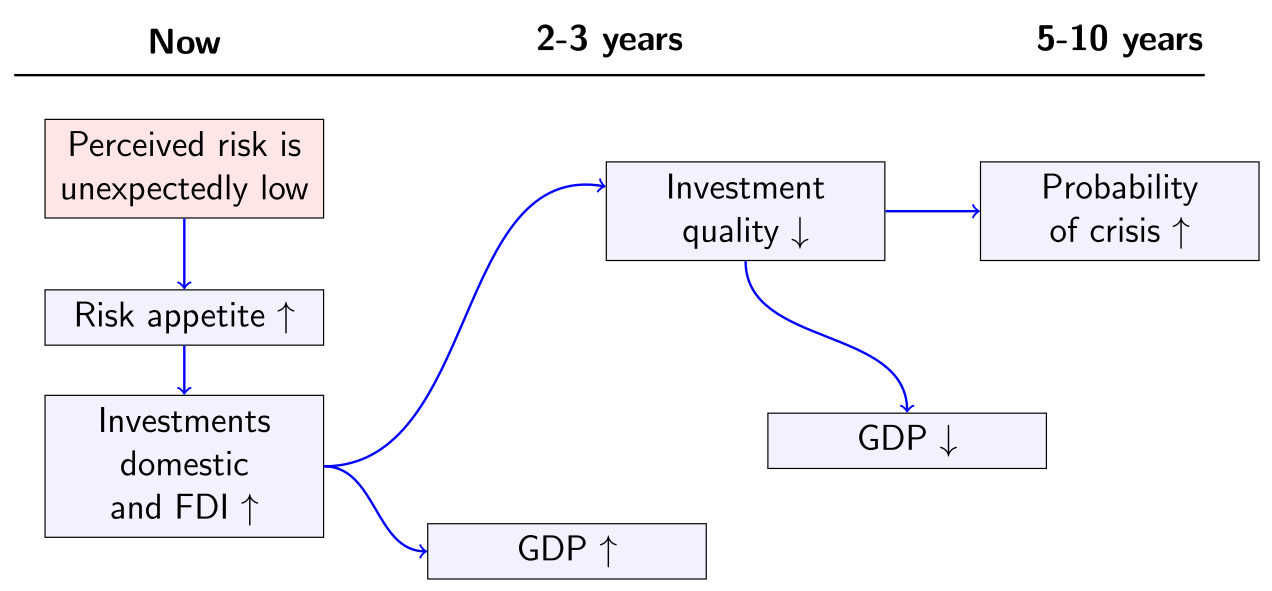
Credit matters too. Only two variables seem to predict crises at all, low perceived risk and credit growth. Low risk comes first, since it drives credit growth. If investors think the world is safe, it is perfectly OK to take on more risk, which means more borrowing.
Low perceived risk is thus good for growth, unless we are in an excessive credit cycle. Then the consequence for GDP is negative, and the reversal is worst when low risk persists.
The AI boom in the US fits the pattern. It fuels growth at home and, through global risk appetite, investment in the rest of the world. If it turns sour, the reversal hits the US, but likely even harder elsewhere, especially in emerging markets.
In the worst case, the bubble bursts. Growth falls, and when the government bails out the banks and props up the economy, private losses become public debt. Cue the fiscal heart attack.
Vicious feedbacks
Most of these worries only push the debt arithmetic the wrong way. Ageing, climate and energy shocks come from outside, and an AI bubble bursting is a chain of events, not a loop. A vicious feedback is where the outcome comes back and makes the cause worse.
The slow ones first. The debt death spiral above is one, and populism feeding on the arithmetic is another.
Fiscal dominance is the third. When debt servicing gets expensive, the pressure on the central bank to hold rates down grows. The markets suspect it will give in and want more compensation, so long rates go up, and debt servicing gets more expensive still.
Then the fast ones. A leveraged investor who gets a margin call has to sell, which pushes yields up and brings more margin calls. That is what happened to the UK pension funds in 2022, and why the ECB worries about hedge funds unwinding.
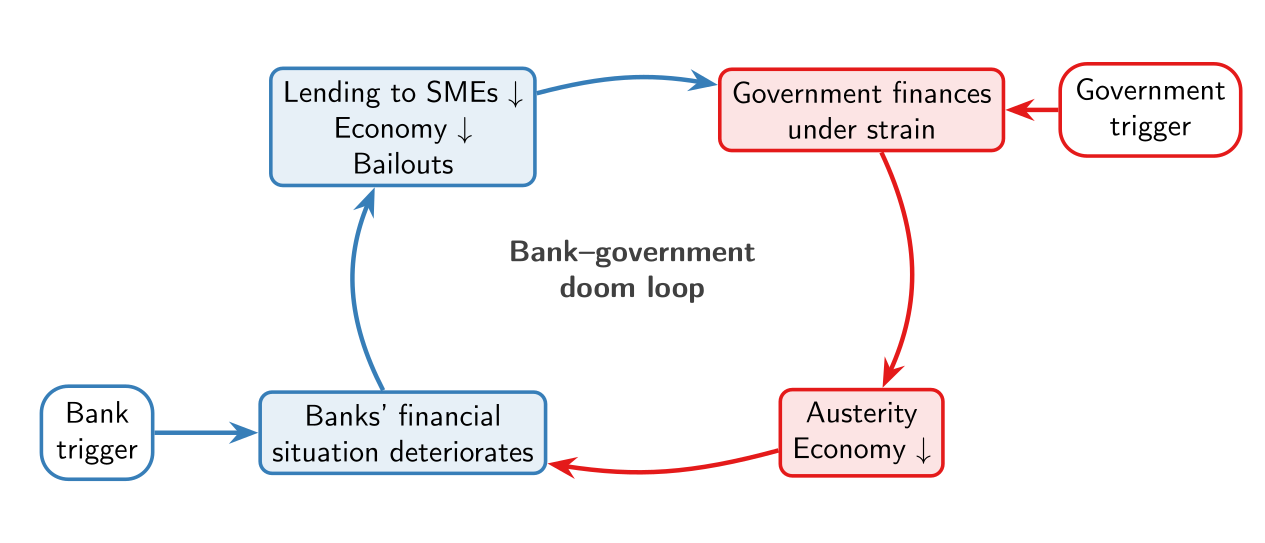
Banks and sovereigns are closely linked. The banks hold a lot of their own government's debt, so when yields rise the banks get weaker, lend less and may need a bailout. That weakens the government and yields rise further, the bank-sovereign doom loop I wrote about in 2017.
All of them except populism run through the same number, the interest rate on government debt, which is why they amplify each other. And a feedback loop can be there all along, lurking in the background, until the conditions are right for it to emerge, just as with endogenous risk.
What to watch
The trigger cannot be predicted, but we can track the fundamentals.
- How fast higher market rates reach the effective rate on the debt, which depends on its maturity.
- Whether credit, term and liquidity premia start to widen together, as the market rate then jumps at once.
- Whether the central bank starts setting rates to keep debt servicing costs down, especially if it is also a large and persistent buyer of government debt. Monetary policy then serves the government's financing needs, not price stability, what we call fiscal dominance.
- How long the US stretch of low perceived risk and fast credit growth lasts, since the reversal is worse the longer it persists, for both America and the rest of the world.
- Whether banks put off recognising losses as rates rise, for example on loans against empty offices, and the supervisors let them. At zero rates, almost any rental income covers the interest, but not at 5%.
- Whether European voters will accept bailing out banks or governments in other member states. Without that, "whatever it takes" may not be available next time.
So
Where will the next crisis come from? While a sufficiently large shock in any of these individual factors could trigger us into a crisis, a more likely scenario is where one or more end up worsening the debt arithmetic, putting us into a situation where it takes a smaller and smaller shock to trigger us into a crisis — the straw that broke the camel's back.
This means that the chance of a systemic crisis continues increasing at a steady pace. It seems unlikely governments will do anything about this until it's too late. The ultimate disciplining device may be the bond market. As James Carville put it in 1993, "I used to think that if there was reincarnation, I wanted to come back as the president or the pope ... But now I would like to come back as the bond market. You can intimidate everybody."
Our options are the subject of a future blog.
Government debt is general government gross debt from the IMF World Economic Outlook. Maturity is the average term to maturity of central government marketable debt from the OECD Global Debt Report 2026, except for Malaysia, where it comes from the Ministry of Finance.
"Hedge Funds Are the Wild Card in the Turbulent Bond Market", The Wall Street Journal, 14 September 2026. The pension figures are from a CEPR report cited there. The hedge fund holdings are from Ted Berg and Daniel Stemp, "Hedge Funds' Cash Treasury Holdings Reach $2 Trillion", Office of Financial Research blog, 19 August 2026.